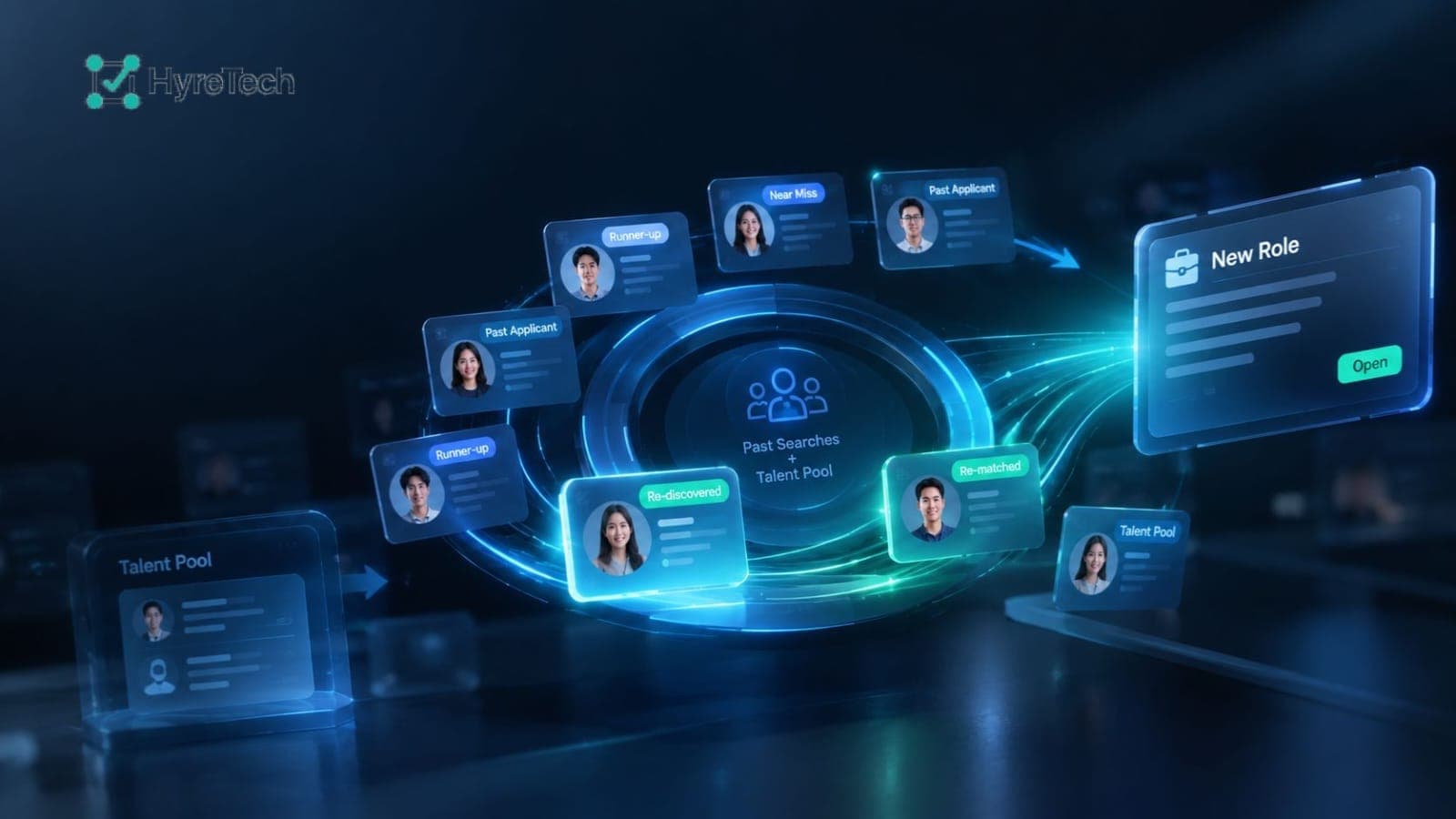
Candidate rediscovery means searching the people you have already screened before you pay to source new ones. That includes last quarter's runners-up and the people who sent a CV when nothing was open. For hiring teams in Singapore there is a second half to it: the PDPA decides how long you may keep those people on file. HyreTech covers both pools. You can search every candidate in your workspace in plain English, and your talent pool is re-matched each time you open a role.
Most hiring runs one search at a time. You post a role, screen who applies, hire one person and close the role. The shortlist behind that hire, people who were qualified but not the single best fit that week, rarely gets looked at again.
Six months later a similar role opens and the default is to start over with a new posting, new sourcing spend and a new screening pass, as if that shortlist never existed.
What is Candidate Rediscovery?
Candidate rediscovery is the practice of evaluating people already in your hiring system against new openings, instead of treating their file as closed once a search ends. It covers past applicants and anyone who joined a talent pool without applying to a specific role.
Tools sold under the name work in one of two ways. Some let a recruiter search the existing database when a new role opens. Others re-match stored profiles against the new role automatically. Either way, they only work on data you still hold and are still allowed to use, which is where Singapore's retention rules come in.
The Two Pools You Already Paid For
The first pool is silver medalists: candidates who made it deep into a previous process, sometimes to the final round, and lost out only because someone else was a slightly better fit for that role. They have already shown real qualifications and already invested time in your process.
The second pool is people who never had a matching role to apply to. They found your careers page and liked what they saw, but nothing open fitted them, and most setups give them no way to stay in the running for whatever opens next.
Both pools are sourcing work you have already done. The shortage is rarely qualified people. Most hiring tools evaluate applicants against one open role at a time and lose track of everyone who does not get it.
| Silver medalists | Talent-pool sign-ups | |
|---|---|---|
| Who they are | Finalists and near-misses from a closed search | People who sent a CV when no open role fitted |
| Why they get lost | The role they were assessed for closes | There was no role to attach them to |
| How to rediscover them | Search your database before you post the next role | Re-match the pool against each new role |
| What to tell them when you collect their data | That you may consider them for other roles | That you will consider them for future roles, and how long you keep their data |
Why Past Candidates Go Stale
Rediscovery has a shelf life. In SHRM's reporting on silver medalists, Adam Stafford, CEO of the recruitment analytics firm Recruitics, puts the limit at about six months since your last contact with someone.
Past that, it is hard to know whether they are still available. He also describes employers as sitting on "a gold mine of talent profiles" once you count the cost of going back to the top of the hiring funnel.
Shannon Pritchett of hireEZ, quoted in the same piece, makes the other half of the case: silver medalists have already been vetted and have already shown interest in your company.
A CV in a database does not update itself. Two practical rules follow. Contact your most recent near-misses first. Then confirm they are available and interested before you assess anyone for the new role.
How to Run Candidate Rediscovery When a Role Opens
- Write the new role's must-haves as a sentence and search your existing candidates with it before the job ad goes live.
- Start with people from the last six months. They are the likeliest to still be available and to remember you.
- Check what your application notice said. If it only covered the role they applied for, tell them about the new role and ask before you assess them for it.
- Reach out personally. Name the role they applied for before and say why the new one fits them.
- Ask them to apply to the new role. Their application is then scored on the new role's criteria, the same way as everyone else's, so the comparison stays fair.
How HyreTech Handles Candidate Rediscovery
HyreTech treats the two pools differently.
Past applicants are found by search
Semantic search takes a plain-English query, such as "backend engineer with Go and payments experience", and ranks everyone in your workspace by meaning rather than exact keywords. Each search uses one AI credit. Candidates you import from your current ATS with their CVs join the same pool once HyreTech has scored them, so history from another system becomes searchable.
HyreTech does not re-score past applicants against a new role by itself. A recruiter runs the search. Candidates who applied through HyreTech may also get an email, at most once a week, listing publicly listed roles at the company they applied to that match their CV. They can unsubscribe from it.
Talent-pool sign-ups are re-matched automatically
Turn on the talent-pool form on your HyreTech company page and candidates can send a CV when no open role fits them. Each CV is matched against your open roles when it arrives, which uses one credit.
When you open a new role, the pool is re-matched against it straight away, and a nightly run catches anything that was missed. Re-matches are free. What reverse role matching is explains the idea behind it.
Both kinds of match are for building a shortlist, not a full evaluation. When a rediscovered candidate applies to the role, or you move a talent-pool sign-up onto it, HyreTech scores them against the role's criteria like any other applicant, including evidence from their GitHub when their CV links a profile.
How the match score is built covers the weights and penalties, and running hiring in HyreTech shows the full setup.
How Long Can You Keep Candidate Data in Singapore?
The PDPA does not set a number. Section 25 requires an organization to stop retaining personal data once the purpose it was collected for is no longer served and keeping it is no longer necessary for legal or business purposes.
The PDPC's Advisory Guidelines on the PDPA for Selected Topics (revised May 2024) apply that to hiring:
- Data on applicants you did not hire should be kept only as long as a business or legal purpose needs it, and those applicants can still ask to see and correct it (paragraph 6.8).
- Sending a job application gives deemed consent to assess that application. Using the data for another purpose needs notice and consent, unless an exception applies (paragraph 6.2).
- Considering people for future job opportunities is a valid business purpose. The PDPC gives it as an example for former employees, and warns that holding data with no clearly defined purpose, or for an indeterminate period, raises the risk of breaching the Act (paragraphs 6.27 and 6.28).
For a rediscovery program, that comes down to three habits. Tell applicants and talent-pool sign-ups, when you collect their data, that you may consider them for future roles. Pick a review period that fits how often you hire for similar roles, and delete or re-confirm the people who pass it. Act on deletion requests promptly.
HyreTech's talent-pool form tells candidates their profile is kept until they or the company ask for it to be deleted, and deletion requests are handled within 30 days (how deletion works).
HyreTech does not delete inactive profiles automatically, so the review period is yours to run. Our PDPA guide for AI hiring covers the other obligations, and AI hiring compliance in Singapore, Australia and New Zealand compares the rules elsewhere in APAC.
See Who is Already in Your Pipeline
If your past applicants sit in a spreadsheet or another ATS, start free, import them with their CVs and search them for your next role. The Free plan includes 20 credits, and each imported candidate scored against a role uses one.
To see talent-pool re-matching on a real role first, book a demo.
FAQ
What is candidate rediscovery?
It is evaluating people already in your hiring system, such as past applicants and talent-pool sign-ups, against new openings instead of sourcing from zero for every role.
What is a silver medalist candidate?
A finalist who was qualified for a role but lost out to one stronger candidate. Silver medalists have already been screened and have already shown interest, so they are the first people to check when a similar role opens.
What do candidate rediscovery tools do?
They either let recruiters search an existing candidate database for a new role, or re-match stored profiles automatically when a role opens. HyreTech does the first for past applicants and the second for talent-pool sign-ups.
How long can you keep unsuccessful applicants' data in Singapore?
The PDPA sets no fixed period. Under section 25 you may keep it only while a business or legal purpose needs it. Considering someone for future roles can be that purpose, but the PDPC expects a clearly defined purpose and warns against holding data indefinitely.
Can candidates join a talent pool without applying to a role?
Yes. With HyreTech's talent-pool form turned on, candidates send a CV from your company page. It is matched against your open roles when it arrives and again whenever you open a new role.
Does HyreTech re-score past applicants automatically when a new role opens?
No. You find past applicants with semantic search, which a recruiter runs. Talent-pool sign-ups are the ones re-matched automatically, when a role opens and again in a nightly run.