
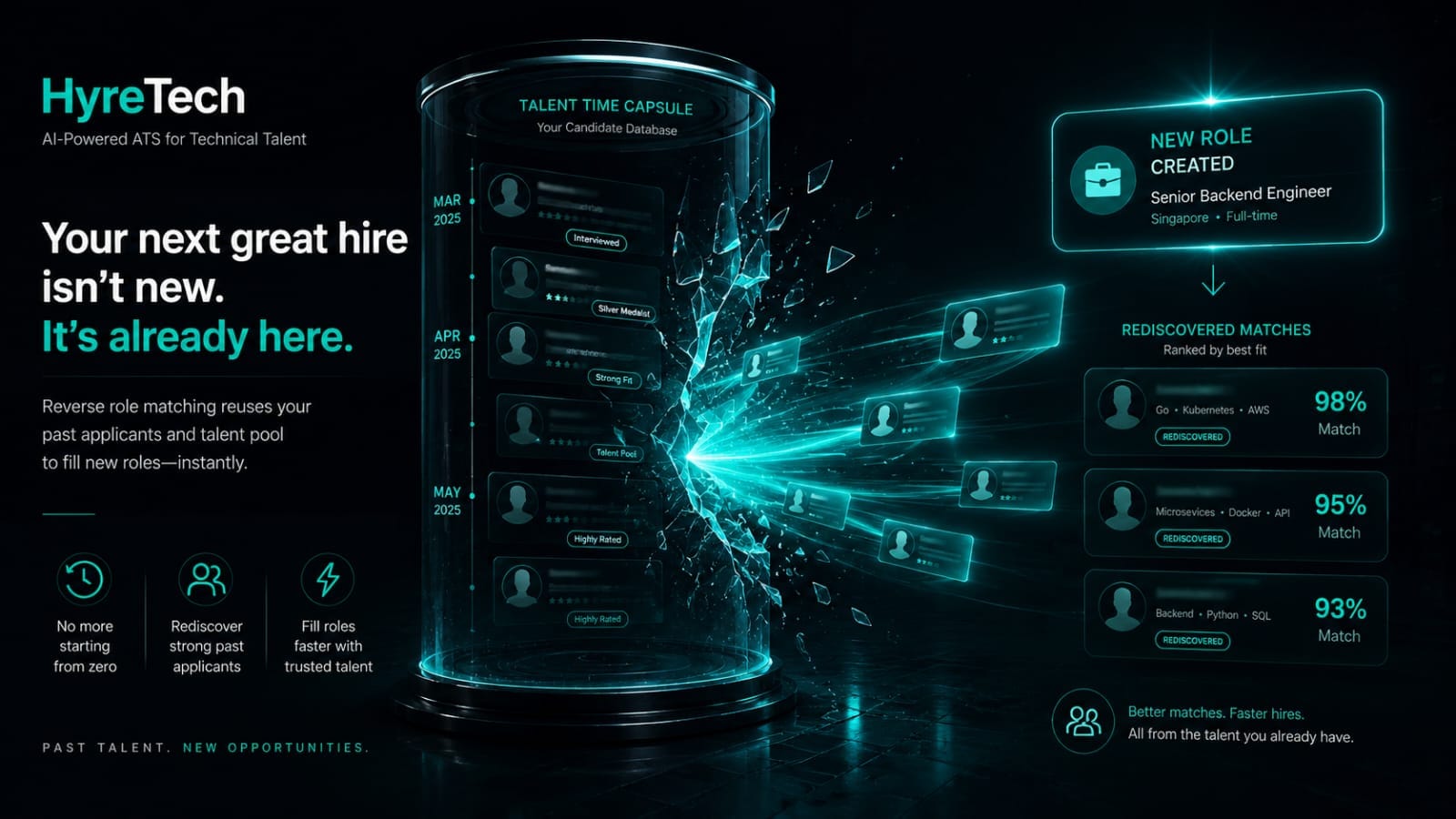
Reverse role matching is a feature in some AI-powered ATS platforms that matches the candidates already in your talent pool to newly opened roles, instead of requiring a recruiter to search for candidates one role at a time.
In HyreTech it works on your talent pool: every time a role opens, people who sent a CV through your talent pool form are matched against it, including roles that didn't exist yet when they joined. Past applicants to other roles are found with semantic search instead.
Most applicant tracking systems are built around one direction of search: you open a role, and you go looking for candidates who fit it.
But every recruiter who has hired for more than one position knows the frustrating flip side of that model — the strong candidate who applied three months ago for a role that's now closed, sitting untouched in your database while you post a brand-new job and start the search from zero.
Reverse role matching flips that process. Instead of only helping you search for candidates, it has the system match the people already in your talent pool against each role you open.
For HR teams and headhunters hiring technical talent across Singapore and the wider APAC region, this matters more than it sounds, because technical candidate pools fill up fast and get stale even faster.
What Reverse Role Matching Is (and Isn't)
The name can be confusing, because "reverse recruiting" already means something else in HR.
It typically describes a process where a candidate acts as their own recruiter — proactively identifying companies they want to work for and reaching out to the hiring manager directly, rather than waiting for a job posting to apply to.
Reverse role matching, as used in an AI ATS, is a different concept entirely. It's not a candidate-side service, it's an employer-side feature.
The "reverse" refers to the direction of the match, not who the software is working for. Instead of the employer searching for candidates, the system matches the people in its talent pool against new roles, and surfaces the result to the recruiter's dashboard.
How Reverse Role Matching Works Inside an AI ATS
Step 1: Every candidate gets a semantic profile, not just a resume file
For reverse matching to work, a system first needs to understand each candidate as more than a static PDF. An AI ATS with semantic candidate search breaks a resume down into structured, meaning-based data — skills, experience, project history — rather than treating it as a block of text to keyword-search later.
Step 2: New roles are matched against your talent pool, not just new applicants
When a new job is created, a traditional ATS waits for people to apply. A reverse-matching system does the opposite: as soon as the role opens, it compares the role against every profile in your talent pool, including people who never applied to anything and simply sent a CV through your careers page.
Step 3: Matches are surfaced to the recruiter, not left buried in a search bar
The output isn't a search result you have to go looking for. It shows up as a ranked list of candidates for the new role, generated automatically, so a recruiter never has to remember to manually re-check the pool every time a position opens.
The Problem It Actually Solves: Your Database Is Bigger Than Your Search Bar
This matters because most hiring teams already have far more usable talent sitting in their systems than they realize.
SHRM notes that highly qualified runners-up from previous open roles — often called "silver medalists" — represent a real opportunity for fast, effective hires once a relevant position reopens, precisely because they were already vetted and simply weren't selected for that specific role.
The trouble is that revisiting them usually depends on a recruiter remembering to search, which rarely happens under normal hiring pressure. Semantic search turns that into one plain-English query, and for people in your talent pool, reverse role matching runs the check automatically every time a role opens.
For HyreTech specifically, this connects directly to the branded career pagewhite-labeled career portal, which includes a talent pool intake form so candidates can submit their CV even when there's no open role that fits them yet.
Without reverse matching, that submission would sit passively in the database. With it, that same candidate gets evaluated against every role you open afterward — including the ones that didn't exist yet when they applied.
Reverse Role Matching vs. Traditional Candidate Search
| Aspect | Traditional ATS Search | Reverse Role Matching |
|---|---|---|
| Starting point | Recruiter opens a role, then searches | New role is matched against your talent pool automatically |
| Who's evaluated | Only candidates the recruiter thinks to search for | Everyone in your talent pool. Past applicants are found by search |
| When it runs | Manually, whenever a recruiter remembers to check | Automatically, when a role opens, with a nightly catch-up |
| Risk | Strong candidates go unnoticed if search terms don't match their profile wording | Candidates are matched on meaning, not on whether anyone searched for them |
Why This Matters More for Technical Hiring in Singapore and APAC
Technical roles are especially prone to this problem. A backend engineer who applied for a role in March and didn't get it may be an excellent fit for a similar opening in July, but only if someone remembers to look.
As covered in why more HR teams in Singapore and APAC are switching to AI ATS, regional teams are already dealing with high application volume and candidates who describe similar skills in inconsistent ways.
Reverse role matching adds a second layer of value on top of that: it doesn't just help you screen candidates faster today, it keeps everyone in your talent pool in view each time your next role opens, and a quick search brings back runners-up from earlier searches.
Getting Started
Reverse role matching is one of several features included in HyreTech's core feature set, alongside semantic candidate search, GitHub profile enrichment, and overnight candidate analysis — all designed for teams that hire technical talent regularly rather than occasionally.
Ready to see it applied to your own hiring pipeline? Get started free and set up your first role today.
FAQs
Is reverse role matching the same as reverse recruiting?
No. Reverse recruiting is a candidate-side service where a recruiter searches for jobs and applies on behalf of a job seeker. Reverse role matching is an employer-side ATS feature that automatically matches your existing candidate database against newly opened roles. The two terms sound similar but describe unrelated things.
Do I need a large candidate database for reverse role matching to be useful?
It helps, but it's not required. Even a small talent pool benefits, because the feature's value comes from not having to manually remember to re-check candidates — a step that gets skipped regardless of database size when hiring volume picks up.
Does reverse role matching replace the need to post a job and attract new applicants?
No. It works alongside your normal hiring process. New applicants still come in through job postings and your career page; reverse role matching makes sure people in your talent pool are also considered for new roles automatically, and past applicants are one semantic search away.
How is this different from candidate rediscovery tools some ATS platforms offer?
The underlying idea is closely related: both aim to resurface qualified candidates already in a database instead of starting every search from zero. In HyreTech the two work together: reverse role matching re-matches your talent pool automatically when a role opens, and past applicants are rediscovered with a semantic search a recruiter runs.
Can candidates who never applied to a specific role still get matched?
Yes, if they've joined a general talent pool — for example, through a career page's talent pool intake form. Reverse role matching evaluates everyone in the talent pool, including people who never applied to a specific role.