
Hiring tech talent in Singapore and across the APAC region often feels overwhelming: hundreds of CVs, tight timelines, and constant pressure to “get it right” the first time.
To combat local talent shortages, many regional teams expand their search to include tech hubs like Indonesia. However, whether hiring locally or cross-border, HR teams and headhunters still rely on agencies, manual screening, or legacy ATS—options that are slow and hard to scale for modern tech hiring.
In this article, we’ll break down why more teams are switching to AI-powered ATS, how it compares to agencies and traditional tools, and where an AI ATS like HyreTech fits into your hiring strategy.
The Frustration of Hiring Tech Talent Without the Right Tools
If you work in HR or as a headhunter in Singapore or manage regional recruitment across APAC, this scenario probably feels familiar.
You open a new role for a developer or data engineer and within a few days, your inbox or ATS is flooded with CVs from both local candidates and remote applicants across the region. Only a small portion of them are relevant, but you still have to read through a huge pile to find the right people.
Without the right tools, you end up choosing between spending more hours on manual screening or risking a bad hire because you rushed the process. That’s why, since 2024, more HR teams in the region have started looking at AI-powered ATS like HyreTech to manage volume, speed, and quality at the same time.
The Old Ways of Hiring: Agencies, Manual Screening, and Legacy ATS
Recruitment Agencies
Recruitment agencies like Robert Walters or regional tech-focused firms are often the first option when internal teams feel overloaded. You tell them what role you need, and they handle sourcing, pre-vetting, and shortlisting before sending candidates to you.
This approach works well when you want curated candidates for critical roles and don’t mind paying a placement fee. However, agencies can be slower when you have multiple roles or high hiring volume, and you’re still dependent on their capacity, speed, and priorities rather than your own.
Manual CV Screening
Many HR teams still rely on manual CV screening as their default process. You post a job, collect CVs, open each one, and decide who to contact. It’s simple, familiar, and completely under your control.
The downside is that manual screening does not scale. It’s slow, tiring, and you can easily miss good candidates because you’re trying to move quickly. For tech roles that attract a lot of applicants across APAC, manual screening quickly becomes a bottleneck rather than a quality filter.
Legacy ATS and HRIS Systems
Some companies have moved beyond email and spreadsheets and now use ATS or HRIS platforms like LinovHR, Zoho Recruit, Manatal, Rippling, or peopleHum.
These tools are good at centralizing applications, tracking candidate stages, and providing basic reports such as time-to-hire.
However, most legacy ATS solutions still rely on keyword and rule-based matching. They search for exact words in CVs and apply simple filters like years of experience or specific tools. They rarely understand context, related skills, or technical depth, which means recruiters still spend a lot of time manually reviewing and ranking candidates.
What Makes AI ATS Different from Legacy ATS
Traditional ATS: Keyword Matching Only
Traditional ATS systems were designed mainly to organize information, not to truly understand it. When you search for “PHP developer” in a typical legacy ATS, it looks for CVs that contain that exact phrase.
Candidates who describe themselves as “back-end engineer (PHP)” or “software engineer working with PHP” might not show up in the top results, even though they are highly relevant.
This rigid keyword matching often leads to missed opportunities and extra manual work, especially in technical roles where titles and stacks can be described in many different ways.
AI ATS: Semantic Search and Smarter Matching
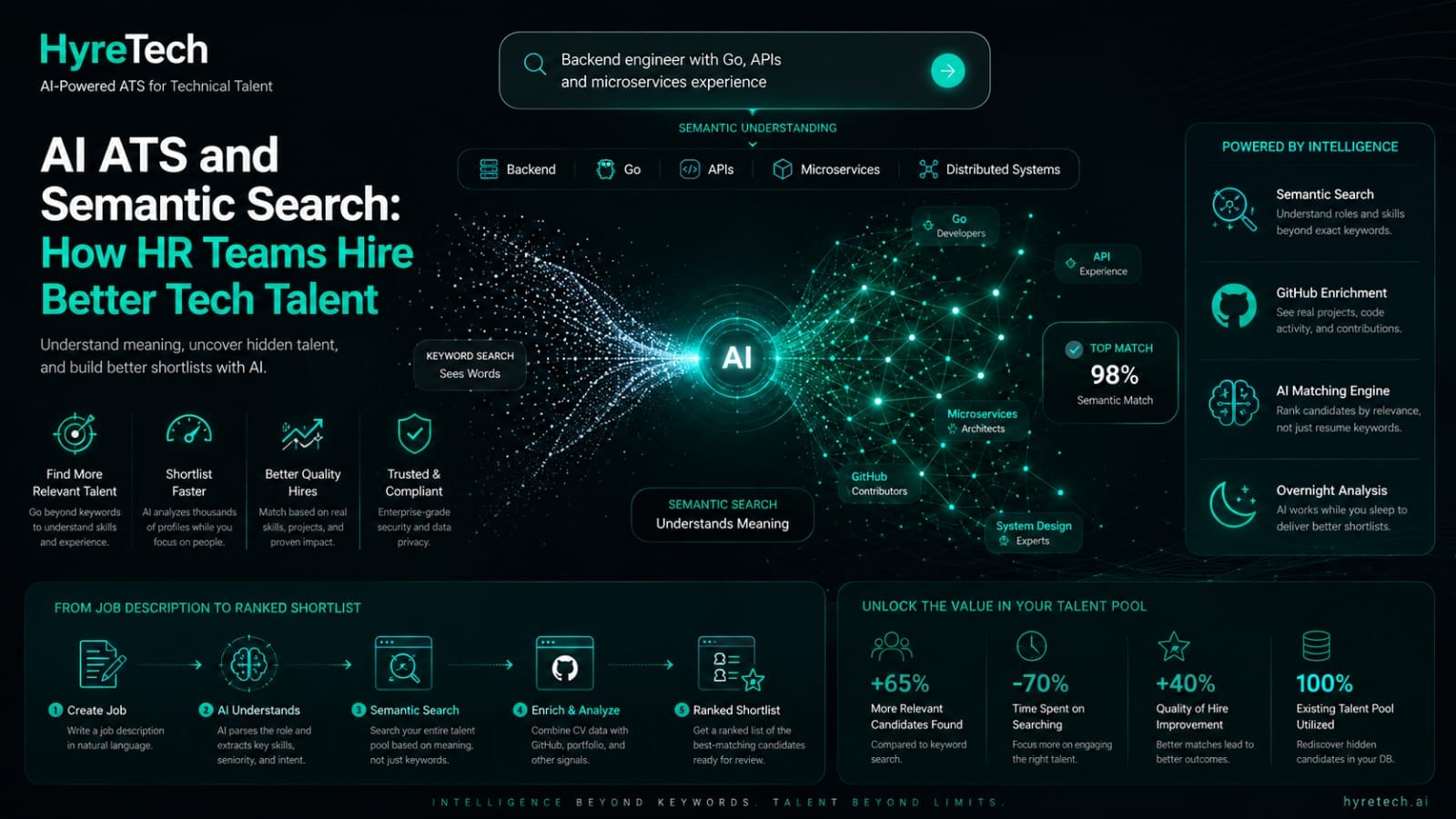
An AI ATS like HyreTech works differently. Instead of relying only on exact keywords, it uses semantic candidate search to understand the meaning behind a role and the skills associated with it.
To see this technology in action, you can explore how AI ATS and semantic search help recruitment teams build faster, more accurate shortlists.
HyreTech analyses CVs and technical profiles to recognize related skills, technologies, and experience, even when the wording is not identical. It also enriches candidate data with GitHub profiles and portfolios, so you’re not limited to what’s written in a CV.
In practice, this means you see more relevant candidates earlier, spend less time screening, and reduce the risk of missing strong talent because of inconsistent wording.
Why AI ATS Works Better for Tech Hiring in Singapore and APAC
Handling Technical Profiles and Portfolios
Tech candidates often have more to show than just job titles. They contribute to GitHub, build side projects, and work with different stacks over time. A traditional ATS is not built to read or interpret that kind of data.
HyreTech is designed for teams that hire technical talent and includes GitHub profile enrichment as part of its feature set. By analyzing repositories and technical signals alongside CVs, it helps you understand the real capabilities of a candidate, not just the labels on their resume.
Scaling Screening Without Losing Quality
When you receive dozens or hundreds of applications for each tech role, the real challenge is deciding who should go to the next stage. Manual screening and simple filters quickly hit their limit.
With AI-powered matching and automated overnight candidate analysis, HyreTech can process large volumes of candidates while you’re offline. By the time you start your day, you get a ranked list of profiles that best fit each role, so your time is spent talking to the right people instead of sifting through every CV.
Example: Faster Shortlists for Developer Roles
| Aspect | Recruitment Agency | Legacy ATS / HRIS | AI ATS (e.g. HyreTech) |
|---|---|---|---|
| Matching | Human judgment | Keyword + rules | Semantic search + AI matching |
| Technical Data | CV + interview | CV mostly | CV + GitHub + portfolio integration |
| Scale | Limited by team size | Good for tracking | High-scale screening + ranking |
| Speed | Days to weeks | Same as manual | "Perfect hire in half the time" |
| Tech Understanding | Recruiter's judgment | Limited | AI understands technical roles better |
Imagine opening a role for a full-stack developer in Singapore or sourcing remotely from Jakarta. Instead of manually searching for “React”, “Node.js”, and “TypeScript” in every CV, you define the role once and let HyreTech’s AI do the heavy lifting.
The system uses semantic search to identify candidates whose skills, experience, and technical projects align with the role—even if they describe their work differently.
You get a shortlist faster, with better coverage of relevant candidates, and can move to interviews sooner without sacrificing quality.
When to Use Agencies, Legacy ATS, or AI ATS
If you're also weighing an AI recruiter or an AI headhunter service, we compare all three options in AI recruiter, AI headhunter, or AI ATS? What each one does for an APAC hiring team.
When a Recruitment Agency Still Makes Sense
Recruitment agencies are still valuable, especially when you’re hiring for senior or highly sensitive roles where you want deep, hands-on support. They bring market knowledge, negotiation skills, and personal relationships that no software can fully replace.
If you only hire occasionally or need help with a very specific leadership role, partnering with an agency can still be the right decision, even if you use an ATS internally.
When a Legacy ATS or HRIS Is Enough
A legacy ATS or HRIS can be enough if your hiring volume is low and you just need a central place to store applications and track stages. For some companies, basic workflow management and simple reporting are already a big improvement compared to email and spreadsheets.
If you are not hiring tech roles regularly, or if your candidate volume is manageable, a traditional ATS may still serve its purpose without the need for AI-driven matching.
When an AI ATS Is the Better Choice
An AI ATS like HyreTech becomes the better option when you:
- Hire technical roles regularly.
- Receive high volumes of applications.
- Want to move faster without lowering your hiring standards.
HyreTech is built as an AI-powered ATS for teams that hire technical talent, combining semantic search, GitHub enrichment, reverse role matching, and automated analysis to help you “find the perfect hire in half the time”.
How HyreTech Helps HR Teams Hiring Tech Talent
HyreTech focuses on solving the day-to-day problems of HR teams and headhunters who hire tech talent in Singapore and across broader APAC markets.
Instead of acting as a general HR platform, it specializes in candidate search and matching for technical roles, making it easier to tap into regional talent pools like Indonesia or manage local talent applications.
Key features include semantic candidate search, GitHub profile enrichment, reverse role matching, and automated overnight candidate analysis. Together, these features reduce time spent on manual screening, highlight the best candidates for each role, and give recruiters clearer insights into their tech talent pipeline.
Conclusion
Hiring tech talent in Singapore and the wider APAC region is not getting easier, but the tools you use can make a big difference. Agencies, manual screening, and legacy ATS each cover part of the process, yet they struggle to keep up when you’re dealing with complex roles and high volumes of applicants.
By adding an AI ATS like HyreTech to your toolkit, you get smarter search, better matching, and faster shortlists for technical roles. Instead of spending your energy on filtering, you can focus on interviewing and closing the right people for your team.
Ready to see how an AI ATS can change the way you hire tech talent?
Experience the future of tech recruitment today. You can Get Started Free by filling out our quick setup form and start matching talent instantly, or explore our features first to See How It Works.
FAQs
What is the main difference between an AI ATS and a traditional ATS?
A traditional ATS focuses on storing applications and supporting basic keyword search and filtering. An AI ATS like HyreTech adds semantic search, AI-driven matching, and profile enrichment on top of that. This means it can understand context and related skills, helping you surface more relevant candidates with less manual effort.
Do I still need a recruitment agency if I use an AI ATS?
You might still use agencies for certain roles, especially senior or highly specialized positions where you want hands-on support. An AI ATS is most powerful when you want to manage more of the hiring process in-house and deal with larger volumes efficiently. Many teams use both: agencies for select roles and AI ATS for ongoing, repeatable hiring.
Is an AI ATS only useful for big companies?
No. Smaller companies and startups can benefit just as much, particularly if they hire tech roles regularly but don’t have a large HR team. An AI ATS effectively acts like an additional recruiter that works in the background, ranking candidates, analyzing profiles, and highlighting the best matches based on each job description.
How does HyreTech handle technical profiles like GitHub?
HyreTech goes beyond CVs by enriching candidate data with GitHub profiles and portfolios. The platform analyses repositories and contributions to better understand a developer’s skills and real-world experience. This gives you a fuller picture of the candidate, especially for roles where practical projects matter more than job titles.
Is AI in recruitment replacing human recruiters?
AI in recruitment, including HyreTech, is designed as a decision-support layer, not a replacement for humans. The AI takes care of repetitive tasks like parsing resumes, ranking candidates, and matching profiles to roles, while recruiters and hiring managers still make the final decisions. This allows people to focus on interviews, stakeholder alignment, and building strong relationships with candidates.
External references: