
Hiring tech talent in Singapore and across the APAC region is tricky: hundreds of CVs, similar-looking profiles, and job titles that mean different things.
Traditional ATS and keyword search make it easy to miss strong candidates just because they use different words.
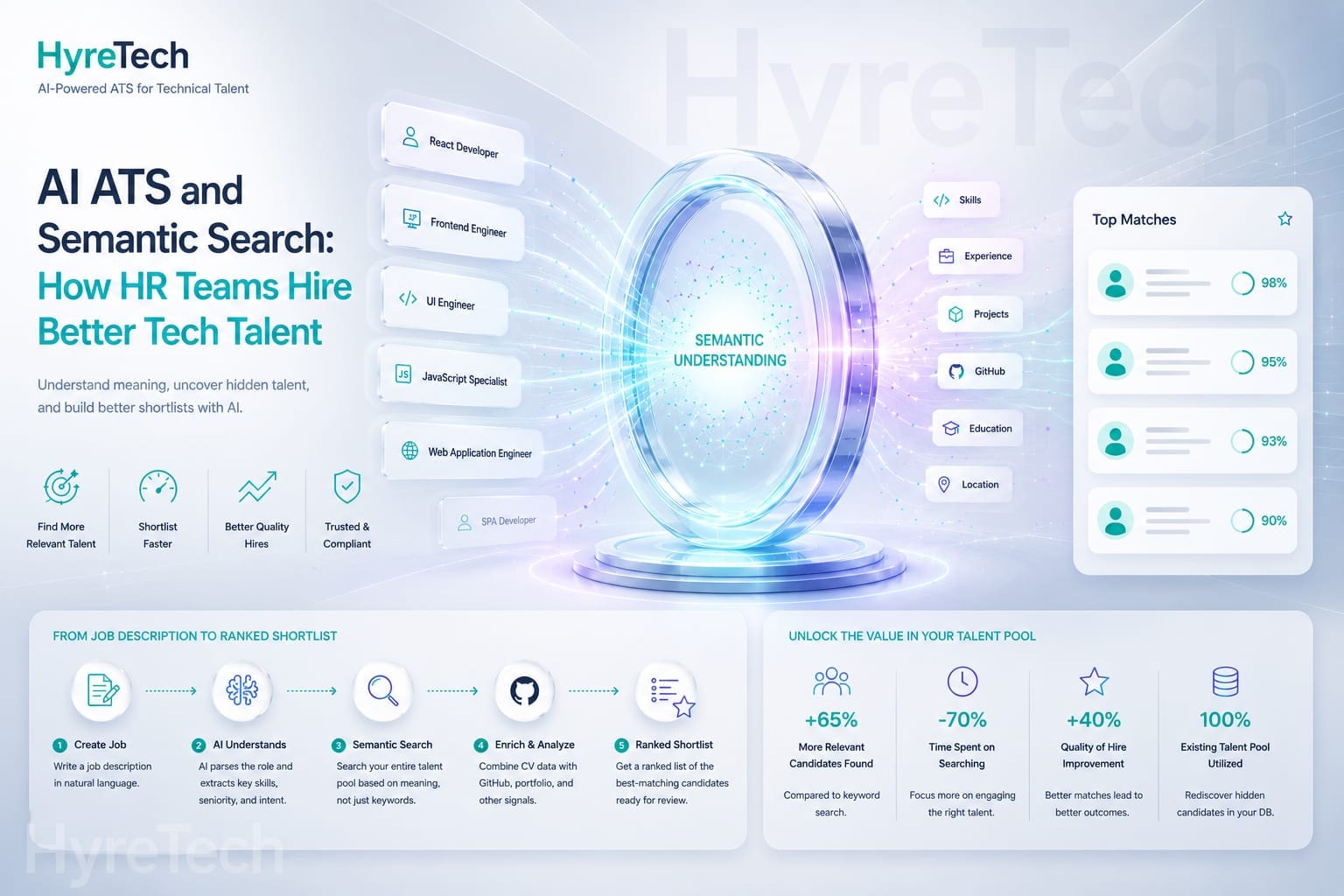
In this article, we’ll explain what semantic search means inside an AI ATS, how it changes the way HR teams and headhunters find tech candidates, and how HyreTech uses semantic search, GitHub enrichment, and AI matching to deliver better shortlists, faster.
Why Keyword Search Falls Short in Tech Hiring
If you’ve ever searched your ATS for “React developer” or “data engineer”, you already know the limits of simple keyword matching.
You get a list of candidates who use those exact words, but you’re never sure you’re seeing everyone who actually fits the role.
In tech hiring, this is a daily problem. Candidates describe similar work in very different ways, mix multiple stacks, and use varied job titles.
A traditional ATS that only looks for exact matches can easily hide strong profiles because they wrote “front‑end engineer working with React” instead of “React developer”.
What Semantic Search Actually Does in an AI ATS
From Matching Words to Understanding Roles
Semantic search shifts the focus from “find this exact word” to “understand what this role and skill set mean”. Instead of scanning CVs for literal matches, an AI ATS with semantic search interprets the intent behind a job description or search query.
This advanced capability is one of the core reasons why modern HR teams are switching to AI-powered ATS platforms over legacy systems.
When you look for a “backend engineer with experience in REST APIs and Go”, a semantic engine recognizes backend development, server‑side skills, and related technologies, even if candidates don’t repeat your exact phrases. This is powerful in recruitment, where titles and tech stacks are rarely standardized.
How Semantic Search Works in Practice
Behind the scenes, semantic search uses language models and embeddings to map words and phrases into a space where similar concepts sit close together.
For HR and headhunters, the experience is much simpler:
- You describe the role (skills, seniority, tech stack) in natural language.
- The AI ATS parses and understands that description.
- The system searches your entire candidate database based on meaning, not just exact strings.
You don’t need to guess every possible keyword variation. You focus on describing the role clearly, and the system handles the complexity of matching.
How Semantic Search Changes the Way You Search for Candidates
From Boolean Strings to Natural Language
With a traditional ATS, search often feels like building a formula: combining job titles, tools, and Boolean operators. With semantic search, you can be closer to how you’d brief a hiring manager.
Instead of typing:
"(React OR Vue) AND JavaScript AND frontend AND Singapore."
you can search for something like:
“Front‑end engineer with modern JavaScript frameworks, experience building dashboards, based in Singapore or open to regional APAC talent.”
A semantic engine is designed to pick up the core intent, extract the skills and constraints, and surface candidates whose profiles align—even when their CV wording is different.
Surfacing Strong Candidates You Would Otherwise Miss
Because semantic search looks at meaning, it can surface candidates who are often missed with simple keyword search, such as:
- People with non‑standard job titles for essentially the same work.
- Candidates who describe outcomes and projects more than tool lists.
- Profiles from adjacent roles with overlapping skills.
In tech hiring, this means you’re less likely to lose a good developer or data engineer just because they phrase their CV differently.
How HyreTech Uses Semantic Search a nd AI Matching for Tech Roles
Built for Teams That Hire Technical Talent
HyreTech is positioned as an AI‑powered ATS for teams that hire technical talent, not a general HRIS with a small recruitment module. That focus matters, because technical profiles are often more complex and less standardized than non‑technical roles.
By combining semantic candidate search with tech‑specific signals, HyreTech helps HR teams and headhunters in Singapore look both locally and across the wider APAC market to evaluate candidates based on real skills and experience, not just the labels in their CVs.
Semantic Candidate Search and GitHub Enrichment
HyreTech doesn’t stop at reading CVs. The platform:
- Uses semantic candidate search to understand roles and skills beyond exact keyword matches.
- Enriches profiles with GitHub and portfolio data, so you see real projects and contributions alongside job history.
- Factors these signals into its ranking and matching logic, so your shortlists reflect both stated and demonstrated skills.
For developer roles in particular, the combination of CV plus GitHub is often far more telling than CV alone.
From Job Description to Ranked Shortlist
Imagine you open a role for a full‑stack engineer in Singapore working with React, Node.js, and TypeScript. In a traditional ATS, you might spend time tweaking keyword combinations and filters.
In an AI ATS like HyreTech, you define the role once through a job description or job creation flow. The system then:
- Parses the requirements and understands the key skills you need.
- Run semantic search across your candidate pool.
- Combines CV data with GitHub and portfolio signals where available.
- Uses automated overnight candidate analysis to process large pools while you’re offline.
By the time you log in, you see a ranked shortlist of candidates who best match the role. Your time shifts from “searching and filtering” to "reviewing and speaking with the right people".
Why Semantic Search Matters for HR and Headhunters in Singapore and APAC
Reducing Noise in High‑Volume Tech Markets
In busy tech hubs like Singapore and competitive APAC markets, a single role can attract a large number of applicants. Simple keyword search tends to create a lot of noise: many results with mixed relevance.
Semantic search reduces that noise by prioritizing fit rather than just word overlap. For HR teams and headhunters, this means fewer irrelevant profiles to scroll through and more time spent engaging with candidates who are actually suitable for the role.
Unlocking Value from Your Existing Talent Pool
Many companies already have rich candidate databases built up over years. The challenge is finding the right people inside them when a new role opens. Older or differently written CVs often stay buried.
By re‑indexing your existing candidate pool based on meaning, an AI ATS like HyreTech helps you rediscover strong candidates you might have overlooked previously. You don’t have to start from zero every time you open a new tech role, you can make better use of the talent you already have.
Conclusion
Semantic search is more than a buzzword; it’s a practical shift in how recruiters and HR teams look for talent.
Instead of forcing you to guess the right keywords, an AI ATS with semantic search understands the intent behind your roles and the substance of your candidates’ experience.
For teams hiring tech talent in Singapore and the APAC region, this means more relevant shortlists, less manual filtering, and better use of your existing talent pool. With features like semantic candidate search, GitHub enrichment, reverse role matching, and automated analysis, HyreTech helps you apply AI exactly where it matters most: finding the right technical talent, faster.
Want to see how next-generation AI matching transforms your talent sourcing? Take the first step toward a smarter tech recruitment process. Create an account instantly via our Get Started Free onboarding page, or take a closer look at our platform capabilities by selecting See How It Works.
FAQs
What exactly is semantic search in recruitment?
Semantic search in recruitment is a way of finding candidates based on the meaning and context of skills, experience, and job requirements, not just exact keyword matches. It allows an ATS to surface relevant candidates even when their CVs use different titles or phrases from your job description.
How is semantic search different from Boolean or keyword search in an ATS?
Boolean and keyword searches require you to specify exact terms and operators, and they only return profiles containing those words. Semantic search uses language models to interpret what you’re actually looking for and can identify candidates whose skills and experience align, even if the wording is different. That means less time crafting complex queries and more time reviewing strong profiles.
Do I need a huge candidate database for semantic search to be useful?
No. Semantic search is useful with any database size because it helps you see matches you might miss with simple keyword search. The benefit becomes even more obvious as your talent pool grows and diversifies, because the AI can keep your database usable instead of letting good profiles get buried.
How does HyreTech use semantic search specifically for tech roles?
HyreTech combines semantic candidate search with technical signals such as GitHub activity and portfolio data, so the platform understands not only job titles but also real projects and contributions. This helps HR teams and headhunters identify capable developers and technical talent, even if their CVs aren’t perfectly optimised for traditional ATS.
Will semantic search and AI matching replace recruiters?
No. Semantic search and AI matching in HyreTech are designed as decision‑support tools, not replacements for people. The AI handles repetitive work like parsing CVs, understanding skills, and ranking candidates, while recruiters and hiring managers still make the final decisions. That frees you up to spend more time on interviews, stakeholder alignment, and creating a strong candidate experience.
External references: