
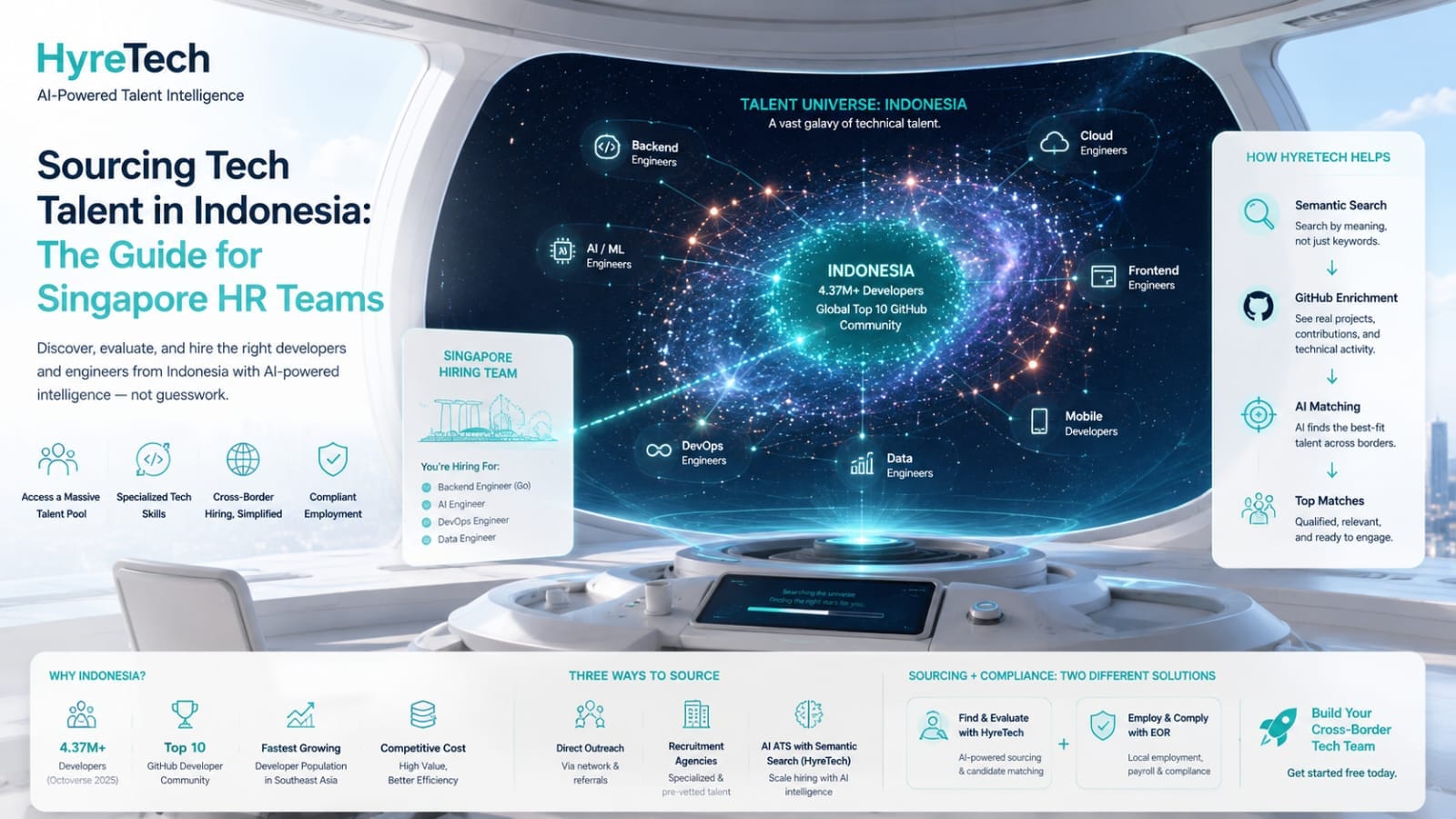
Companies in Singapore are increasingly sourcing developers and engineers from Indonesia because of its fast-growing developer population, competitive costs, and easier availability of specialized technical roles that are harder to fill locally.
This usually works through a combination of remote hiring, cross-border sourcing tools, and a separate compliance solution (such as an Employer of Record) to handle local employment and payroll — sourcing the talent and legally employing them are two different problems that need two different solutions.
Singapore has one of the most competitive tech hiring markets in the region: high demand, a small local talent pool, and salaries that keep climbing for specialized roles.
That combination is pushing more HR teams and startups to look beyond their own borders — and Indonesia, right next door, has become one of the more obvious places to look.
This isn't just a cost story, although cost is part of it. It's also a talent-pool story: Indonesia's developer community has grown fast enough that it now shows up in global rankings, not just regional ones.
Why Indonesia?
It helps to look at where Indonesia actually stands, rather than relying on the general assumption that "Southeast Asia has cheap developers."
According to GitHub's 2025 Octoverse report, Indonesia's developer population more than quadrupled between 2020 and 2025, growing from roughly 900,000 to 4.37 million developers, enough to place it in GitHub's global top 10 for the first time.
The same report notes that Indonesia's digital economy now accounts for close to half of Southeast Asia's entire online economy.
That scale matters for a very practical reason: a bigger, more active developer community means a wider range of skill sets and experience levels to search through, rather than a small, tightly contested pool where every company is competing for the same handful of senior engineers.
What's Driving the Timing Right Now?
Regional talent shortages aren't new, but a few things have made cross-border sourcing feel more urgent recently rather than optional.
One factor, even for companies with no US operations, is the ripple effect of global talent policy. The introduction of a $100,000 US H-1B visa fee in 2025 has already pushed many companies worldwide to rethink where they build technical teams.
Coverage from Computerworld notes that the change is expected to accelerate a broader shift toward distributed global workforces, as the cost and complexity of concentrating technical talent in one high-cost location keeps rising.
Singapore-based companies aren't directly affected by US visa rules, but the underlying logic — that technical talent doesn't need to sit in one expensive hub to be effective — is the same one making cross-border hiring from Indonesia more attractive.
On top of that, remote-first engineering work has simply become normal. A developer in Jakarta working full-time with a team in Singapore is no longer an unusual arrangement; for many technical roles, it's the default.
How Cross-Border Technical Hiring From Indonesia Actually Works
Sourcing talent from Indonesia usually looks like one of three approaches, each with a different tradeoff:
Direct Outreach and Networking
Some companies rely on their own team's connections, referrals, or direct LinkedIn outreach. This works but doesn't scale well past one or two hires, and it depends heavily on who happens to already be in your network.
Recruitment Agencies
Agencies that specialize in Indonesian or regional tech talent handle sourcing and pre-vetting on your behalf. This can work well for a handful of senior or highly specific roles, but it's slower and costlier when hiring regularly or hiring for volume.
An AI ATS with Cross-Border, Semantic Candidate Search
As covered in why HR teams in Singapore and APAC are switching to AI ATS, tools like HyreTech let a Singapore-based team search a candidate database using natural, meaning-based queries — "backend engineer with Go experience, open to remote APAC roles" — rather than being limited to exact keyword matches.
Combined with GitHub profile enrichment, this makes it easier to evaluate a developer's real technical activity, not just what's written on a CV, regardless of which country they're applying from.
The Part That Sourcing Tools Don't Solve: Employment and Compliance
It's worth being direct about this, because it's a common point of confusion: finding and evaluating a candidate is a separate problem from legally employing them.
If a Singapore company wants to formally hire someone based in Indonesia — handling their contract, payroll, tax withholding, and local labor law compliance — that typically requires either setting up a local entity or working with an Employer of Record (EOR) service that already has one.
An AI ATS helps you find and evaluate the right candidate faster. It does not replace the compliance and payroll layer needed to actually employ someone across a border. Companies exploring Indonesia as a hiring market should expect to need both pieces, usually from different providers, working together.
Comparing the Three Approaches
| Approach | Best for | Main tradeoff |
|---|---|---|
| Direct outreach / networking | One-off hires, roles filled through existing contacts | Doesn't scale, depends on who you already know |
| Recruitment agency | Senior or highly specialized roles, occasional hiring | Slower, higher cost per hire, limited by agency capacity |
| AI ATS with semantic search | Regular or higher-volume technical hiring across borders | Still requires a separate EOR or entity for compliance |
Getting Started
If your team is exploring Indonesia as part of a broader APAC hiring strategy, the sourcing side is where an AI ATS like HyreTech's semantic candidate search and GitHub enrichment can help — evaluating technical candidates on real skills and project history rather than CV keywords alone, whether they're local to Singapore or based elsewhere in the region.
Ready to build your cross-border team? Get started free to set up your first role today and begin discovering top technical talent.
FAQs
Is Indonesia the only country Singapore companies source tech talent from?
No. Vietnam, the Philippines, and India are also common sourcing markets. This article focuses specifically on Indonesia because of its scale and proximity to Singapore, not because it's the only option.
Do I need a local entity in Indonesia to hire a developer there?
Not necessarily. Many companies use an Employer of Record (EOR) service instead of setting up their own legal entity, which handles local payroll, contracts, and compliance on their behalf.
Can an AI ATS like HyreTech handle payroll or employment contracts for candidates in Indonesia?
No. HyreTech is a sourcing and candidate-matching tool. Employment, payroll, and compliance for candidates in another country require a separate solution, such as an EOR provider or a local entity.
Is cross-border technical hiring only useful for cost savings?
No. Cost is one factor, but access to a larger, faster-growing developer population — and to specific technical skills that may be harder to find locally — is often just as important.
How is searching for candidates across borders different from searching locally?
The search process itself is largely the same with a semantic AI ATS — you describe the role in natural language and the system searches your candidate pool by meaning rather than exact keywords. The difference is mainly on the employment side, where cross-border hires require additional compliance steps that local hires don't.