
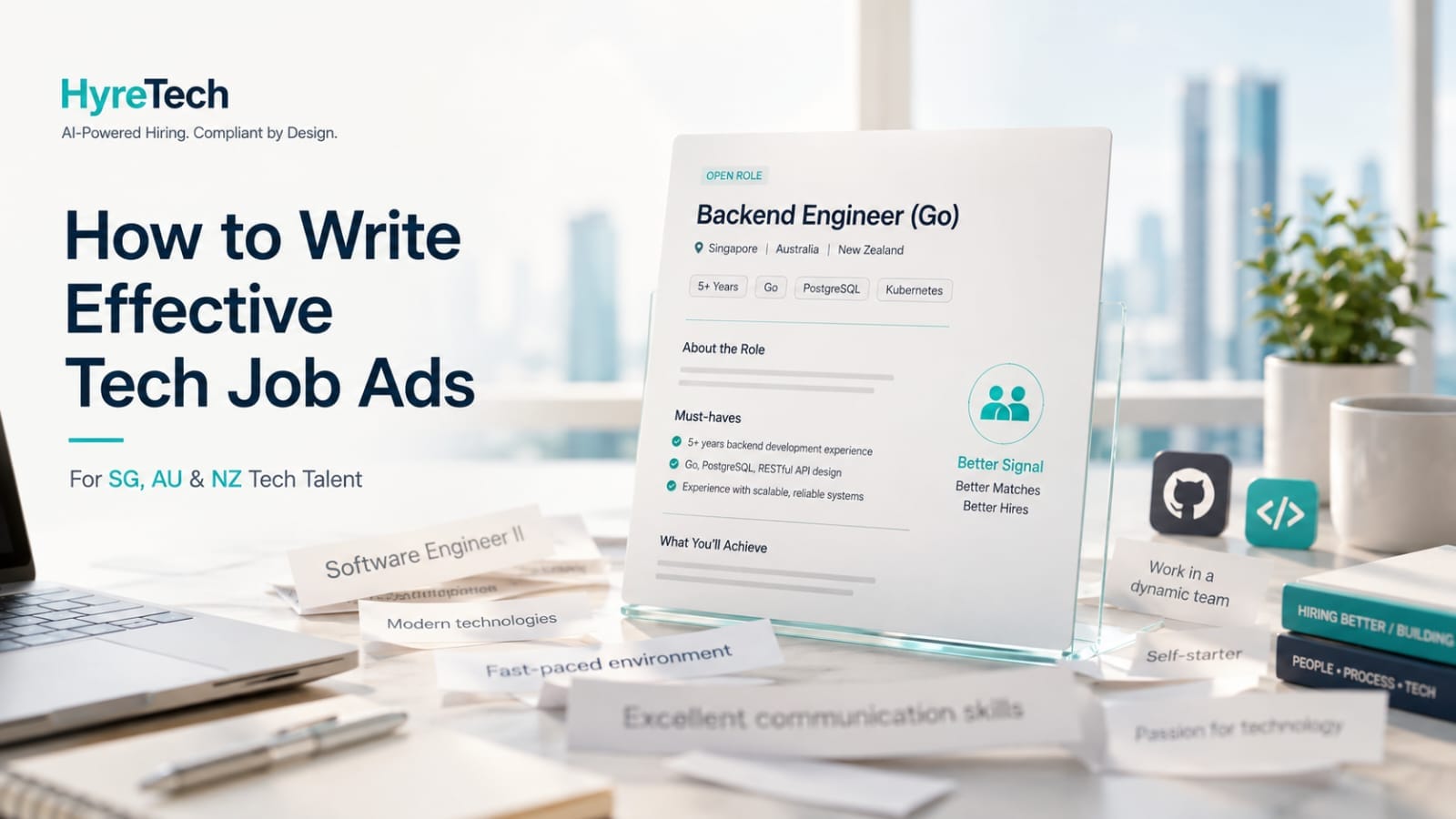
Most job descriptions quietly work against the hiring team that wrote them. A bloated requirements list, a vague title, or a job ad with no pay information doesn't just fail to attract candidates. It actively filters out strong ones who decide, correctly or not, that they don't fit.
For technical roles specifically, where candidates in Singapore, Australia, and New Zealand already have their pick of openings, a weak job description is one of the easiest ways to lose good applicants before a recruiter ever sees them.
This matters more than most HR teams expect. In an Indeed survey of 250 employers, 65% said they'd had to revise a job description after posting it in the past year — most commonly because it brought in either too many unqualified applicants or not enough candidates at all.
That's a signal the job description itself, not the market, was the problem.
Why Job Description Wording Matters Even More With an AI ATS
If you're using a traditional keyword-based ATS — such as JobAdder, the long-standing platform many recruitment agencies across Australia and New Zealand already run on — vague or inconsistent job description wording is mostly a candidate-experience problem.
With an AI ATS that uses semantic search, it becomes a matching-quality problem too. A semantic engine works by interpreting the intent behind your job description — the skills, seniority, and context you describe — so a clearer, more specific job description doesn't just read better to a human candidate, it also gives the AI more accurate signal to match against.
Vague titles like "Software Engineer VI" or requirement lists copied from three years ago don't just confuse candidates; they give a semantic matching engine less to work with too. Precision helps on both sides of the process at once.
The Most Common Job Description Mistakes That Filter Out Good Candidates
Losing qualified candidates rarely happens at the interview stage; it usually starts with how the role is presented. These core mistakes actively work against your recruitment goals:
Requirement Lists That are too Long
According to Indeed's survey data, job seekers most commonly reported spending just 3–5 minutes reading a job description before deciding whether to apply, and Indeed's own guidance recommends sticking to 5–10 bullet points of requirements where possible.
A 20-line list of "must-haves" for a mid-level developer role reads less like a job description and more like a wish list, and it disproportionately discourages strong candidates from applying.
Research cited by Forbes' HR Council notes that women in particular are less likely to apply for a role unless they meet nearly every listed qualification, which means an inflated requirements list can quietly narrow your candidate pool in ways you didn't intend.
No Pay Information — Increasingly Conspicuous in Australia and New Zealand
Neither Australia nor New Zealand currently mandates that employers publish a salary range in a job ad, the way a growing number of US states do. But both countries have moved firmly toward pay transparency in a different way: banning pay secrecy.
In Australia, under the Fair Work Legislation Amendment (Secure Jobs, Better Pay) Act, as set out by the Fair Work Ombudsman, any pay rate stated in a job ad since 7 January 2023 can't undercut minimum entitlements, and since June 2023, employers can no longer enforce pay secrecy clauses that stop employees or candidates discussing remuneration.
New Zealand followed with its own Employment Relations (Employee Remuneration Disclosure) Amendment Act 2025, in force from 27 August 2025, which similarly bans employers from penalizing anyone for disclosing their pay.
Neither law forces you to put a number in the ad itself. But in a market where employees can now openly compare notes on pay without fear of repercussions, a job ad that stays silent on compensation looks increasingly out of step — candidates can and do find out anyway, just later in the process, when misalignment is more costly for everyone.
In Singapore, your Job Ad may have Compliance Obligations of its Own
Singapore takes a different regulatory approach again — not a pay-secrecy ban like Australia and New Zealand, but a fair-hiring requirement tied to how the ad is run.
Under the Ministry of Manpower's Fair Consideration Framework (FCF), most job vacancies linked to an Employment Pass or S Pass application must be advertised on MyCareersFuture for at least 14 consecutive days, and employers can't make an offer to a candidate during that window. The point is to give the local workforce a genuine chance to apply before a foreign hire proceeds.
Getting this wrong isn't just a candidate-experience issue: MOM can debar non-compliant employers from hiring on work passes for 12 to 24 months.
This matters for how you write and manage the job description itself. A vague, rushed posting that clearly wasn't written to attract real applicants — recycled text, an unrealistic requirements list, or an ad quietly closed and reopened to restart the clock — is exactly the pattern MOM's guidance flags as going through the motions rather than fairly considering candidates.
A well-structured, honestly scoped job description isn't just better marketing; in Singapore, it's closer to the compliance baseline.
Vague or Internally-Focused Job Titles
A title like "Digital Solutions Engineer II" might make sense on your internal org chart, but it's not what a backend developer searches for. Sticking to industry-recognized titles helps both candidates and AI-driven matching correctly identify the role.
No Distinction Between must-haves and nice-to-haves
Lumping every desirable skill into one undifferentiated list makes it hard for a strong candidate to self-assess whether they should apply, and just as hard for an AI system to weigh which skills are actually decisive.
A Practical Structure for Technical Job Descriptions
A job description that works for both candidates and AI matching generally includes:
- A clear, industry-standard job title — not an internal-only title.
- A short mission or context statement — one or two sentences on why the role exists and what it's responsible for.
- Must-have requirements, capped at 5–10 bullet points — the qualifications that are genuinely non-negotiable.
- Nice-to-have skills, listed separately — signals you're open to candidates who don't check every box.
- Specific tech stack and tools — named technologies (e.g., "Go, PostgreSQL, Kubernetes") rather than vague categories like "modern backend technologies."
- Compensation range, where possible — not always legally required, but increasingly expected by candidates across all three markets.
- What success looks like in the first 3–6 months — gives technical candidates a concrete sense of scope.
A Before-and-After Example
It's easier to see the difference than to describe it. Here's a typical opening paragraph before a rewrite:
That's vague on title, vague on stack, and front-loads soft skills over the technical substance a developer actually scans for. Restructured using the format above:
The second version gives a human reader a concrete reason to self-select in or out within seconds — and gives a semantic matching engine specific, unambiguous signal (Go, PostgreSQL, REST API, Kubernetes) instead of a soft-skills paragraph it has to guess the technical relevance of.
Common Mistake vs. Better Approach
| Common Mistake | Better Approach |
|---|---|
| 20+ bullet points of requirements | 5–10 must-haves, with nice-to-haves listed separately |
| Vague title like "Software Engineer II" | Specific, searchable title like "Backend Engineer (Go)" |
| No pay information at all | A stated range where possible — not always mandatory, but increasingly expected |
| Generic tech stack ("modern web technologies") | Named tools and frameworks the team actually uses |
| One long undifferentiated paragraph | Structured sections: context, must-haves, nice-to-haves, stack, comp |
Getting Started
You don't have to build a job description like this from a blank page every time.
HyreTech's AI-generated job description feature takes a role title and a few bullet points and drafts the full description, requirements, and screening questions for you — already structured the way this article recommends, and ready to refine rather than write from scratch.
Paired with with semantic search and GitHub enrichment, a well-structured job description also gives the matching engine cleaner signal to work with from the moment a role goes live, and works well alongside features like reverse role matching, which re-evaluates your existing talent pool every time a clearly defined new role opens.
Want to try it yourself? Start free and generate your first AI-drafted job description in minutes — no credit card, no sales call required. Prefer to see it walked through first? Book a demo and we'll show you exactly how it fits your current hiring process.
FAQs
How many requirements should a technical job description have?
Indeed's guidance recommends capping the requirements list at around 5–10 bullet points, separating true must-haves from nice-to-haves, since most candidates spend only a few minutes deciding whether to apply.
Is a salary range legally required in job postings in Australia or New Zealand?
No. Unlike a growing number of US states, neither Australia nor New Zealand currently requires employers to publish a salary range in a job ad. Australia does require that any pay rate you do state in an ad meets minimum entitlements, and both countries have banned pay secrecy clauses, meaning employees and candidates can freely discuss pay once they're in the process. This isn't legal advice — check current requirements with legal counsel for your specific situation.
Does Singapore require anything specific in a job posting?
If the role could lead to an Employment Pass or S Pass application, yes — under MOM's Fair Consideration Framework, the ad generally needs to run on MyCareersFuture for at least 14 consecutive days, and employers can't offer the role to a candidate during that window. It's a fair-hiring and process requirement more than a content-formatting one, but a vague or clearly recycled job description works against you here too, since it's the kind of pattern MOM's guidance treats as a red flag. This isn't legal advice — confirm your specific obligations, including any exemptions, with MOM's current guidance or legal counsel.
Should I include a salary range in a Singapore job posting?
It's not a formatting requirement the way FCF's advertising rules are, but candidates still consistently rank compensation as one of the most important parts of a job description, so including one remains good practice.
Does job description wording affect AI-based candidate matching?
Yes. A semantic AI ATS interprets the meaning and context behind a job description, so specific, well-structured wording — clear titles, named tech stack, distinct must-haves — gives it a more accurate signal than a vague or generic listing does.
Can AI actually write a good job description on its own?
It's a strong starting point, not a finished product. A tool like HyreTech's job description generator can draft a structured first version from a title and a few bullet points in seconds, but the details that make it accurate — the real tech stack, the real scope, the real must-haves — still need a human who knows the role to review and adjust it.
What's the biggest mistake technical job descriptions make?
Overloading the requirements section is one of the most common issues — it discourages qualified candidates from applying and makes it harder for both human recruiters and AI matching systems to identify what's actually essential for the role.