
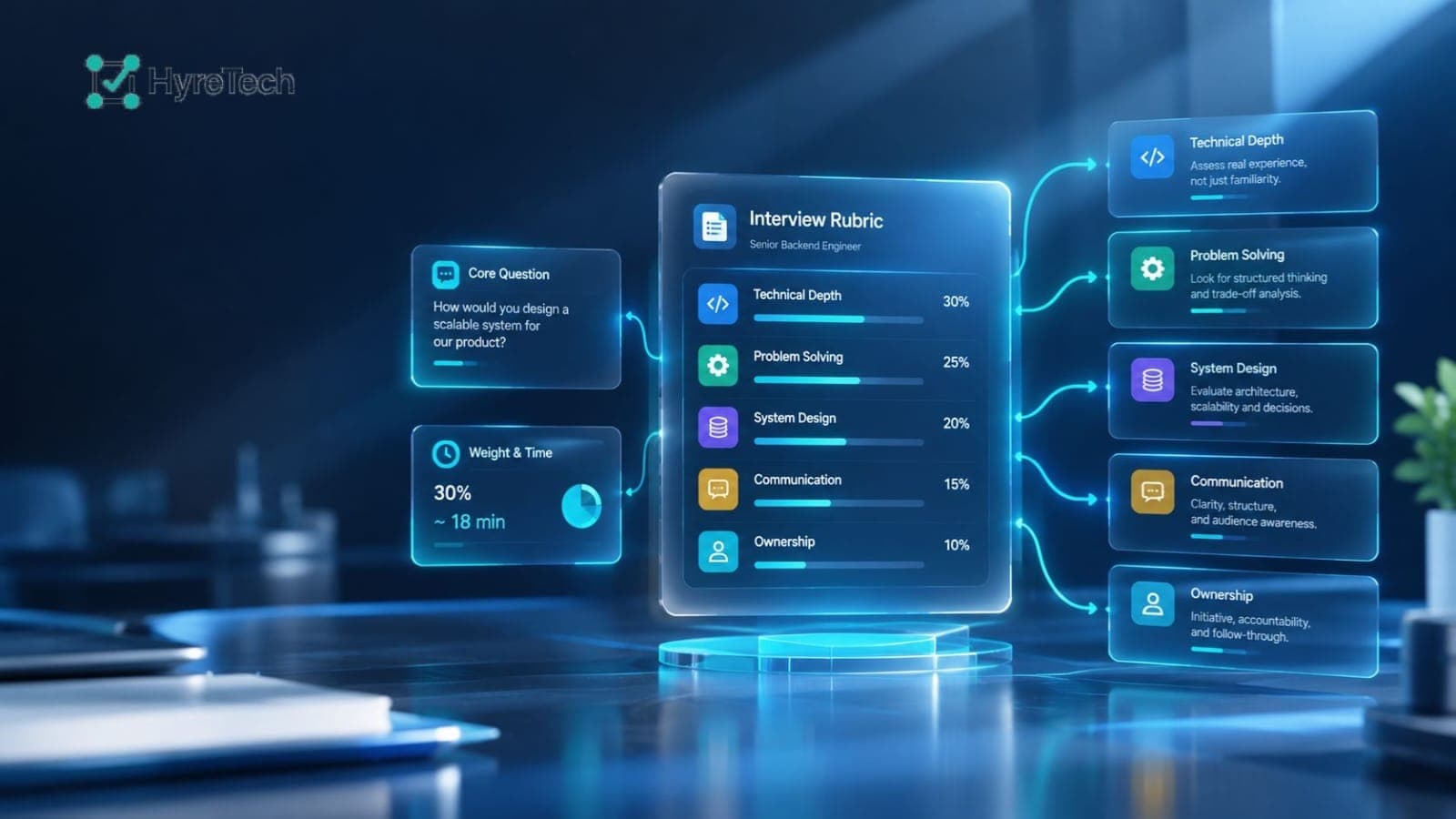
A structured interview rubric for a tech role takes the criteria and weights you screened applicants against and turns each criterion into one core question. Every candidate is asked the same core questions, and each interviewer scores each criterion separately before anyone compares notes. In a 2022 re-analysis of the selection research, structured interviews had the highest average validity of any method examined. In HyreTech, the rubric that ranks your applicants is the one you take into the interview. You schedule from the candidate's page, interviewers get a magic link to write their notes without an account, and those notes land on the candidate's page for the rest of your team.
Many small tech teams screen carefully and then let each interviewer improvise. The evidence gathered at the screen is never used again, and the debrief turns into a vote on impressions.
This guide shows how to carry the rubric from the screen into the interview, which parts HyreTech handles, and what this approach doesn't fix.
Why Structure Matters More Than Interview Style
In a 2022 paper in the Journal of Applied Psychology, Sackett, Zhang, Berry and Lievens re-estimated how well common selection methods predict job performance (free version). Structured interviews came out on top, with a mean operational validity of .42, ahead of cognitive ability tests at .31. Operational validity is an estimated correlation between the method and later job performance, after statistical corrections, on a scale where 0 means no link and 1 a perfect one.
HumRRO's summary of the study puts the number in context: correlations in this kind of research typically fall between -.40 and .40, so .42 is a strong result. The average hides a wide spread. Structured interviews varied a lot from one study to the next, and the authors warn that a given employer can't count on getting the average. So a structured interview isn't automatically a good one.
HumRRO's Cheryl Paullin, writing from practice rather than from the study, says the best ones are grounded in a detailed analysis of the job and run by well-prepared interviewers.
If you already write a rubric to screen applicants, you have done most of that analysis. A rubric is a compact description of the job: a handful of criteria, a weight for each, and a bar to clear.
Early-stage teams already use this logic at the screen, as we describe in how startups hire their first engineers without a recruiter. The interview is where the same rubric collects its second round of evidence.
A Structured Interview Rubric Template For a Tech Role
Take each criterion and write one core question that surfaces evidence for it. The example below uses the senior backend rubric from how the match score is built.
| Screening criterion (weight) | Core interview prompt | Evidence to listen for |
|---|---|---|
| Ships end-to-end features (30%) | "Walk me through the last feature you took from idea to production." | Scope they owned, trade-offs, what they cut |
| Depth in our stack (25%) | "Here is a failing query in a service like ours. How do you find the cause?" | Specific tools and the order of their reasoning |
| Works without a spec (20%) | "Tell me about a time the requirements were unclear. What did you do first?" | Questions asked, assumptions written down |
| Production ownership (15%) | "Describe an incident you were on call for." | Detection, fix, follow-up |
| Written communication (10%) | A short written exercise, or a design note they wrote | Clarity and structure |
The weights also tell you how to split interview time. In a 60-minute interview, a criterion worth 30% earns about 18 minutes and one worth 10% about 6. Without that discipline, interviews drift toward whatever the interviewer finds most interesting, which is rarely what the role needs most.
Use The Gaps in The Screening Scorecard as Probes
A screening scorecard is also a list of questions. In HyreTech, each criterion score comes with a short explanation, and when the resume has no evidence for a criterion, the explanation says so. That is your cue to ask. A candidate who undersold a relevant project scores low on that line, and the interview is where you find out whether the project exists.
Two more sources of probes are worth using for technical roles:
GitHub Evidence
When a resume links a GitHub profile, HyreTech reads it as part of the analysis, and what it finds can strengthen or weaken the resume's claims. Candidates without one aren't marked down for it. Ask the candidate to walk you through one repository they chose. Can AI read GitHub to judge tech stack fit covers what a profile can and can't show.
Trust-Score Flags
On Growth and above, the verification trust score flags things like a technology listed years before it was released, an unusually fast jump to a senior title, or the same stack at every employer. It is a prompt to check, not proof of anything, so a neutral question is enough.
Write one probe per gap before the interview. Each candidate is asked about their own gaps, and every candidate still answers the same core questions.
Schedule The Interview and Brief Your Interviewers
The run hiring in HyreTech overview puts interviews in the same loop as the ranked board. Here is how the steps fit together, including the part you still do yourself.
| Step | What you do | Where it happens in HyreTech |
|---|---|---|
| 1 | Agree criteria and weights with the hiring manager | Edit the rubric drafted from the job description before the role goes live |
| 2 | Read the ranked board | Applicants are scored against the rubric as they apply |
| 3 | Decide who to interview | Applicants are labelled Shortlist, Consider or Reject against the role's cut-offs. Nothing is rejected automatically |
| 4 | Book the interview | Schedule from the candidate's page. With Google Calendar connected (Starter and above), a Meet link is created for you. On Free, paste your own link |
| 5 | Bring in interviewers | Each interviewer gets an email with a magic link to that interview. No account needed |
| 6 | Record what interviewers saw | Each interviewer writes a note through the link, and the notes appear on the candidate's page |
Settle the rubric at step 1. Changing it later doesn't re-run the analysis for people who have already applied.
The magic link matters more than it looks. Interviewers on a tech team are usually engineers, not recruiters, and asking them to create an account for one interview is a good way to get late notes.
HyreTech sends one reminder to any interviewer who hasn't submitted notes. The link also shows an interviewer only their own note, so nobody reads a colleague's verdict before writing theirs.
The link doesn't carry the rubric. It shows the candidate's name, the role, the time and a notes box, not the resume or the scorecard. Who can see what is in the help centre. Send each interviewer their criteria and core prompts yourself, in a message or a shared doc. Don't put them in the scheduling form's notes field: that text goes into the candidate's invitation email and the calendar event.
The plan boundary is simple. Free covers one active role and one seat, Starter covers three of each and adds Google Calendar and Meet, and interviewers don't take a seat on any plan. The pricing page lists what each plan includes.
A Five-Step Interview Loop for a Tech Role
- Fix the criteria before the role goes live. Agree the rubric with the hiring manager before the first candidate impresses someone, not after.
- Assign criteria to interviewers. Give each interviewer one or two criteria, so questions don't repeat and no candidate is asked the same thing three times.
- Ask every candidate the same core questions, and keep your own talking short. A common rule of thumb is that the candidate does about 80% of the talking. Follow-ups can vary. The core prompts can't.
- Rate each criterion in writing before the debrief. Ask interviewers to open their note with a rating and one line of evidence for each criterion they own, for example "Production ownership: strong. Ran the postmortem and shipped the alerting fix."
- Debrief criterion by criterion. Start with the highest-weighted criterion, then decide. A gut-feel vote comes last, if at all.
Brief interviewers on what a strong and a weak answer sound like for each question. That is the "well-prepared interviewer" part, and it takes a short conversation, not a course.
What This Approach Does Not Fix
- The match score comes from the resume, not the interview. What an interviewer sees in the room is new evidence and can change the picture. Decisions stay with people.
- Structure is not a guarantee. The research shows wide variation in how well structured interviews work, so the quality of your questions and your interviewers still matters.
- HyreTech has no interview rating form. Interviewer notes are free text, one per interviewer per interview. Per-criterion ratings only exist if you ask for them in a fixed format inside the note, as in step 4.
- Interviewers need your email domain. The magic link goes only to addresses on the same domain as the person scheduling, so an outside interviewer on another company's domain can't be added.
- Plan limits. Google Calendar and Meet need Starter, and Starter covers three active roles and three seats.
Try The Loop on One Live Role
The fastest test is a single role. Start free to publish a role, edit the drafted rubric and read the ranked board. The Free plan includes 20 credits, and analysing an applicant uses one. Move up to Starter when you want Google Calendar and Meet.
If you want help setting up the loop for several roles or a larger interview panel, book a demo and we will walk through your process.
FAQ
What is a structured interview rubric?
A list of the criteria a role needs, a weight for each, one core question per criterion, and what strong and weak answers sound like. Every candidate gets the same core questions, and each interviewer rates each criterion separately before the debrief.
What should a structured interview rubric for a tech role include?
Four to six criteria tied to the work, such as shipping features end to end, depth in your stack, working without a spec, production ownership and written communication. Give each a weight, one core prompt and the evidence to listen for, and split interview time by weight. If you screened applicants with a rubric, start from that one so both stages measure the same things.
Do structured interviews predict job performance better than other methods?
On average, yes. In Sackett and colleagues' 2022 re-analysis, structured interviews had the highest mean operational validity of the methods examined, .42 against .31 for cognitive ability tests. Results varied widely between studies, so how the interview is built and run still matters.
How do I turn a screening rubric into interview questions?
Write one core prompt per criterion, give each criterion interview time in proportion to its weight, and add one probe for each gap the screening scorecard flagged. Keep the weights you used at the screen so the two stages stay comparable.
What is the 80-20 rule in interviewing?
A common rule of thumb says the candidate should do about 80% of the talking and the interviewer about 20%. It is practitioner advice, not a finding from the research on interview validity. In a structured interview it is easy to follow: ask the core question briefly, then use probes to draw out evidence for the criterion.
Can interviewers rate candidates inside HyreTech?
Not with a rating form. Each interviewer gets a magic link to the interview and writes a free-text note, which your team sees on the candidate's page. For structured ratings, ask interviewers to start their note with a rating and one line of evidence for each criterion they own.
I run a small engineering team in Singapore and my interviewers are developers who don't want to log into another HR tool. Can HyreTech schedule interviews, give them access without an account and keep notes on each candidate, and which plan do I need?
Yes. You schedule from the candidate's page, and each interviewer gets a magic link to write notes without an account, as long as they use your company's email domain. The notes appear on the candidate's page. Free covers one active role and you paste your own meeting link. Starter covers three roles and three seats and adds Google Calendar and Meet. Interviewers don't take a seat on any plan.